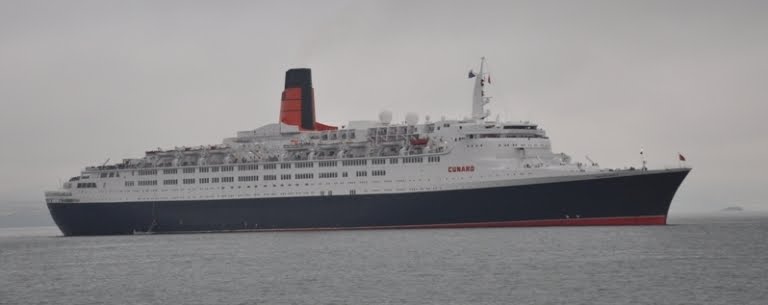
The legendary Cunard Queen Elizabeth 2 on the Hudson River in New York City, October 16, 2008, as she departs for the final time.


21 September, 2010

Cunard Abandons Helvetica

Back in 1967, the choice of using Helvetica for the font for the name of Queen Elizabeth 2 was completely logical.  Cunard wanted a clean break from the previous Queens, designed in the 1930's with Art Deco style interiors and exteriors not too far removed from the days of Titanic.  QE2, right down to the logo, would be revolutionary, new, hip, and a clean break from tradition. Even the funnel was modernized down to a sleek thin appearance, without the traditional Cunard red and black colors. She was sleek and all modern. The Helvetica font used for the name was a perfect fit. Picture Austin Powers dancing in the corridors. Groovy baby!


QE3 Gill Sans Font -photo courtesy of Cunard

The soon to be launched Queen Elizabeth (3) is NOT carrying on in the tradition of using the Helvetica type font in her name.  Gill Sans is similar upon first glance and used today extensively in the corporate world, but something alway looked a little off when I viewed these names on the new Cunard ships.  Actually the the Helvetica font was ONLY used on QE2.  Queen Mary 2, QE2's replacement, uses the common Gill Sans font in her name as well as Queen Victoria.  Graphic artists can spot the difference instantly.  Not so with the masses and the new breed of Cunard passengers guests.


Launching Day - September 20, 1967


Forty-three years ago, the last ocean liner to be built in the UK, Queen Elizabeth 2, was launched into the River Clyde at the former John Brown Shipyard, then called Upper Clyde Shipbuilders after consolidation.


Her Royal Highness Queen Elizabeth II named the ship, famously calling her "Queen Elizabeth, the second,"  and then pushed the button to release the ship down the slipway.  After several seconds of delay, and a nudge from a hydraulic ram added to the slipway to ensure the ship would move, she began her decent down the slipway, out into the Clyde. 


Due to her length,  she carried on into the River Cart opposite the yard, as the previous Queens and countless other ships had done many years ago.


Queen Elizabeth 2 would spend an additional 18 months in the fitting out basin and in sea trials before Cunard would accept the ship for service.  The maiden voyage was delayed, reluctantly by Cunard.


Steam turbine problems delayed acceptance along with labor problems that persisted in the yard. Despite all this, Clydebank built a fine ship, the likes of which we will never see built in the once great yards of the Clyde again

http://www.gla.ac.uk/services/archives/exhibitions/qe2/qe2photogallery1/ -  All photos except the first two,  which I thougth were from that site , but apparently not.

09 September, 2010

QE3 on Sea Trials

QE3 on sea trials in the Adriatic Sea - all photos courtesy http://www.wearecunard.com/

The new cruise ship Queen Elizabeth, which I will continue to call QE3 to differentiate her from her predecessor (sorry Cunard), the original Queen Elizabeth, a true liner proudly built at John Brown Shipyard in Clydebank.  From this angle above, she looks complete, at least from the exterior appearance.  Judging from the bow wave off the bulbous bow, the ship is probably cruising near or at the whopping top speed of 24 knots, several knots slower than QE2's service speed of 28.5 knots. 


Comparisons to QE2 come natural, since she is still in the minds of many and is similarly named.  In reality, Cunard has added to the confusion with their current marketing of the ship as a replacement of QE2 and not correcting this factual error.  Queen Mary 2 was designed from the get go as QE2's replacement.  Comparisons should not apply since the role of this new ship is dramatically different from QE2's.  Times have changed and we have one ship currently handling the transatlantic crossing route; Queen Mary 2, the world's only ship currently in service worthy of the ocean liner designation. 


QE3 and her sistership, Queen Victoria were designed for cruising with the "occasional" transatlantic crossing.  Although marketed by Cunard as liners, they are more cruise ship than liner.  To me, they are well designed for this role, using a proven Carnival Vista class hull design, modified to Cunard specifications.  I just wish they would not have marketed them as "Queens" and reserved that designation for ships expressly designed for the rigors of transatlantic service with the necessary speed to maintain the crossing schedule.  This debate on what makes a ship a liner verses a cruise ship and whether these Vista sisters should be called "Queens" or not will rage on for a long time to come. 


While one can argue that QE3 is a decent looking Vista Class ship, the added cabins in the aft end take the already least attractive part of the ship and make it more boxier and frankly, uglier.  At least Queen Victoria has a stepped down appearance at the stern in a most liner-like side appearance.


From the bow, the only other major difference visible between the Cunard Vista sisters is the semi-enclosed sports deck on QE3, which is visible as the white "top hat" or perhaps a "crown" if you want to continue with the references to the ship's namesake.  At first, I was not a fan of this added appendage, but after seeing the final product, I'm warming up to it. I am looking forward to lawn bowling in this area.


QE2's exterior appearance was crafted in a different era.  Her proportions were carefully crafted by the team of designers for both functionality and beauty.  Her silhouette is perfectly balanced and every feature from her slender bow profile with pronounced flair, to the funnel design, centrally situated due to her original powerplant's boiler locations, are the perfect synergy of form and function.  Like all great design, her design is timeless.  Today's crop of cruisers are all about maximizing interior space to include all the latest features today's typical passengers, or guests as Cunard would like us to call them.  Unfortunately, the outward exterior appearance of the ship suffer, but the obvious counter to this complaint is that once on board, all is lost and the focus is on the interiors.  With this in mind, QE3 appears to have some stunning Art Deco themed interiors.  More on the interiors as updated interior photos are released.


08 September, 2010

QE2's Last Master Captain McNaught Responds to Forum Questions

Captain Ian McNaught, with Paying Out Pennant flying in New York


Captain Ian McNaught has gratiously responded to questions posed to him on the QE2 Story Forum here.  The last series of questions were posed by yours truly, with interesting responses on the viability of getting QE2 back up the Clyde to her birthplace.  With deliberate tact, he addresses the embarrassing grounding on the final approach to Southampton as well as any future plans on returning to Cunard to captain QM2, a desire expressed by fellow Cunarders and McNaught fans.  Also included in the article were several photos I took onboard while docking in Manhattan in January 2008 and in Greenock in October 2008.

Recently, I found my documents from my first time on QE2 in October 2000.  In the Daily Programme, it listed Captain McNaught as "Staff Captain."  With this information, I can now state that I was onboard with Captain McNaught for my entire 22 cumulative days spent onboard!

22 June, 2010

The Clydebank Plan Revised


http://www.clydebankpost.co.uk/news/thisweek/articles/2010/06/09/401219-no-work-on-shipyard-site-for-three-years/

With the fate of Clydebank redevelopment in the balance,  the addition of Clydebank's last great ship would serve as the centerpiece, alongside the great Titan Crane, for showcasing the proud shipbuilding history of the area.  Plans for mixed use redevelopment have turned there back on this rich history and thankfully are stalled due to the economic downturn.  Plans to turn the QE2 into a floating hotel are stalled in Dubai as well.  The merits of returning QE2 home deserve to be studied.  More to follow.....

18 June, 2010

QE2 Sold

Two years ago on this date, this image came up on my screen at work. This image was saved to my hard drive.  While I sat down at my desk for a quiet lunch, I could not believe what I was seeing was true.  A few more frantic Google searches confirmed the news to be legitimate.  I was just not prepared for this news.  All signs coming from Cunard were that the ship would sail on past the 2010 SOLAS requirement deadline, which we had been told the ship would be able to meet with minimal work.   Apparently, Cunard got an offer they just could not refuse.

In only one respect was this good news.  This bit of news sealed the deal regarding whether we were going to go on the transatlantic crossing I had booked months earlier.  This winter crossing was going to be special anyway since it was a tandem crossing with the new Queen Victoria.  I called Dawn at work and told her that there would be no further discussion about cancelling this trip.  We were going on QE2's final winter crossing and we would make it into the Winter Crossing Club with no time to spare. 

I would get in my winter crossing and experience some rough seas with a big grin on my face!

Thank you Myles for posting a reminder of the significance of this day on the definitive site on the Queen Elizabeth 2, the world's most famous ocean liner.  http://www.theqe2story.com/.

What Were They Thinking

http://www.youtube.com/watch?v=ZoVOG-4-_IA&feature=related

While the interiors are far better than the exterior, something disturbs me about seeing brick on the interior of a "ship."  The block of flats above the bridge area look like they were added as an afterthought, after the ship was under construction.  Actually, this construction has some precedent with NCL, who pulled the same thing off with the France/Norway conversion.


This is what the ship looked like in her original configuration as the  S.S. France.  I think Carnival got the inspiration for their iconic funnel from this ship.

The ship in her final incarnation as the NCL S.S. Norway, shortly before the boiler explosion that would ultimately take her out of service forever.

NCL towed the ship from Miami, where the boiler explosion occurred, to Bremerhaven, Germany to allegedly repair the damaged boiler.  After sitting idle for an extended period, the ship was transfered to NCL's parent line, Star Cruises, and the path to Alang began.  Despite numerous attempts to save the ship and deny entry into Alang due to hazzardous materials onboard, the ship was beached and the systematic dismantling of the ship began. 

A sad end to a great ship in Alang, India.  NCL currently owns America's great SS United States,  which may meet the same fate.