Here's my latest eBay purchase, the Launching Day Cover of the the new Cunarder "Q4." What I find interesting with this postcard is the "Q4" logo above the ship and also in the stamp cancellation. At the time this was printed, the ship's name had not yet been revealed, although there had been much speculation.
The "Q4" designation was the internal name of the project by Cunard, the latest in a series of ocean liner designs. "Q1" was the designation for Queen Mary. "Q2" was Queen Elizabeth. "Q3" was the design for the replacement of the first two Queens. As seen in the internal Cunard rendering below, many of the "Q3" design features found there way into the smaller "Q4" design.
Rendering of Cunard's "Q3" design as depicted in Carol Thatcher's book :"QE2: Forty Years Famous"
This design was later scrapped, not to be built, in favor of a smaller ship, more versatile ship with the ability to traverse the Panama Canal and do cruising during the off season from the traditional Transatlantic Crossings. For further discussion on what can now be realistically viewed as a rather ill conceived design that probably would have spelled the end of Cunard, see the discussion
here.
Harland and Wolf "Q4" proposal rendering dated November 27, 1964
Cunard revised their design and solicited proposals from several yards including Harland and Wolff, builders of Titanic, and John Brown. The above rendering was offered for sale on an auction house awhile back and offers a unique view of what may have been. According to the description, this rendering is dated November 27, 1964, two days before the tender for the "Q4" design was due in to Cunard. The funnel depicted looks remarkably like the Sagafjord and Vistafjord ships which would later be acquired by Cunard.
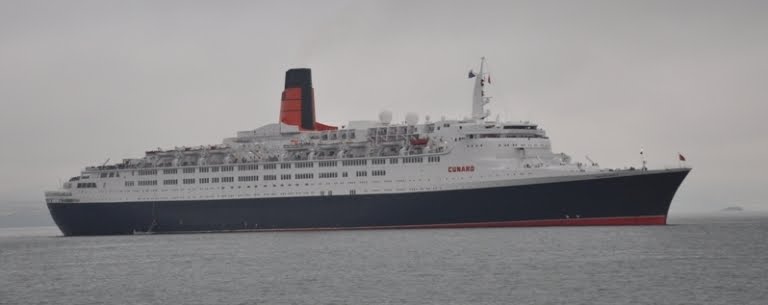
The revised ship, with the design untimately awarded to John Brown Shipyard of Clydeback, Scotland was named "Queen Elizabeth the Second, "infamously on launching day, September 20, 1967 by Queen Elizabeth II and would eventually become the most famous, most traveled ship in the world.
So how did the unique "2" come to be? Apparently, according to various sources, the Queen never opened the envelope, which had only the name "Queen Elizabeth" printed on it for the naming ceremony. Cunard's intention was to name the ship after the first Elizabeth, their common ship naming practice, so technically, as the Queen pronounced, she was Queen Elizabeth
the second. Some would argue, though, that she named the ship after herself! This left Cunard in a predicament. They could not name the ship Queen Elizabeth II without angering the Scots who built her, since Scotland did not recognize the first Queen Elizabeth I. Common folklore is that Cunard came up with the idea to use the Arabic "2" instead of the Roman numeral "II" to get them out of this somewhat sticky situation. Perhaps this is true, but the true facts may never be known if the Queen takes the real story with her to her grave. Read more about the naming controversy
here.


 Posts
Posts