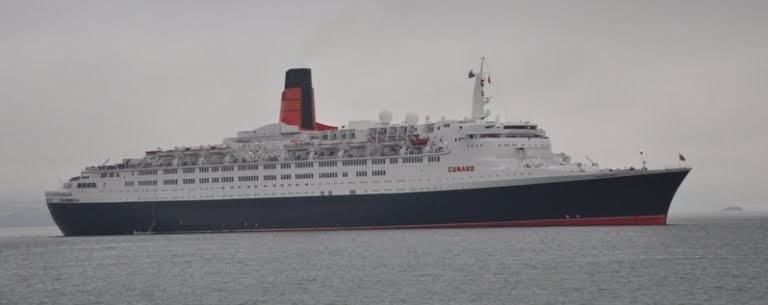
The T.S.S. Cameronia was used for Atlantic crossings at least twice by my family members. The Cameronia was built for the Anchor-Donaldson Line in 1919 by the William Beardmore & Co. Ltd. shipyard located on the River Clyde in Glasgow. The T.S.S. designation either refers to "turbine steam ship" or "twin screw steamer." The ship measured in at 16,365 gross tons, 552 feet long, with a beam of 70 feet. She was a one funnel, two masted, twin screw ship with a service speed of 16 knots. The ship carried a total of 1740 passengers in 265 1st class, 375 2nd class, and 1100 3rd class accommodations. Additional information on the ship can be found
here.
On October 19, 1929, my great aunt Jane (Jean) MacLeod, 18 years old at the time, left Glasgow on the Cameronia to join my grandfather as an immigrant to the United States, arriving in New York City 10 days later on October 29, 1929. At this point, the Cameronia was owned by Cunard as they had purchased the Anchor-Donaldson Line and were running it as a subsidiary of Cunard, often sharing the same facilities and piers in New York.
From left, Susan Connon (Angus) Milne, Isabella (Angus) Grant, John Baird Angus, Janet McDougal Angus, and Mary Jane (Angus) McLeod, my great grandmother.
Ten years later, my great grandmother, Mary Jane MacLeod made a similar trip along with her brother John Angus. An Angus family reunion of sorts was held on the deck of the Cameronia at the pier in New York.
From right to left; Jane McLeod, Mary Jane Angus McLeod, Susan Connon Angus Milne, unknown relative, Isabella (Beldy) Angus Grant with grandchild(?), Charlotte Grant (pretty confident on this) and unknown relative.
I had these photographs of my grandfathers, but could not identify the ship or the year. I studied Bill Miller's book on the Cunard Line, looking in particular for a Cunard ship with woodwork on the bridge area as seen in the background on this picture below, but to no avail. It wasn't until I found the actual records on the Ellis Island site, did I solve the ship mystery.
 Mary Jane (Angus) McLeod Mary Jane (Angus) McLeod and my grandfather William MacLeod
On June 30, 1939, my great grandmother Mary Jane McLeod, departed Glasgow on the Cameronia with her brother John Angus, arriving in New York City nine days later on July 9, 1939. She made this trip without my grandfather, who apparently stayed behind in Peterhead, to see her first grandson who had just been born, my uncle Robert MacLeod. At this time, I am still searching for confirmation as to how long she stayed and how she got home, since crossings at this time would become increasingly dangerous due to the war. At this time, the Cameronia had been sold when the Cunard-Anchor Line had gone into bankruptcy and had been purchased by a newly formed Anchor Line.

The Cameronia continued to make unescorted transatlantic crossings until she was requisioned as a troop ship by the British Admiralty in December 1940. In December of 1942, she was hit with an aerial torpedo, with the loss of 17 lives, but carried on to port for repairs. The ship woould later go on to become the largest troopship to take part in the Normandy Landings. After the end of WWII, the ship was laid up, but was brought out of retirement and converted for use as an Australian emigration ship.
January 1, 1953, the ship was sold to the Ministry of Transport and renamed the "Empire Clyde." After 39 years in service, including hard wartime service, the ship was sold to scrappers in March 1958.


 Posts