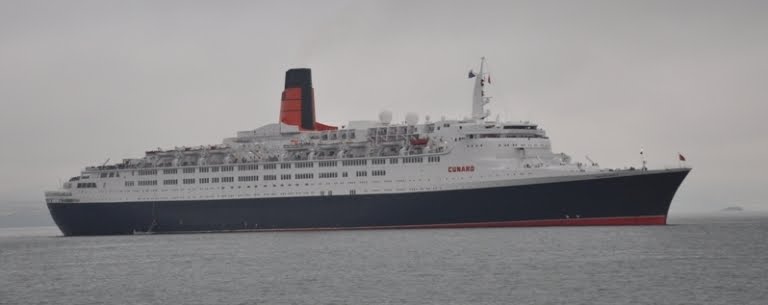
Message above was kindly forwarded to me from a coworker, who is from the Belfast area. I wonder what this celebration of Belfast's maritime history and glimpse of the city's future will be? Would it possibly be related to Titanic or Harland and Wolff? The Titanic Quarter redevelopment was in full swing when QE2 visited Belfast for its one and only time in October of 2008.
Interesting, on the Titanic Quarter's website timeline section, they specifically flag the 2008 visit from New York's "Lord" Mayor Michael Bloomberg and the 2012 opening of their signature Titanic project, no doubt in conjunction with the 100th anniversary of the sinking.
We saw glimpses of the new construction and the remnants of the Harland & Wolff yard, including the graving dock and associated pump house, and the drafting room building, all visible from QE2's berth in the harbor.
The massive yellow Harland & Wolff cranes dominated the skyline, along with their equally massive building, which has been leased out in recent times to movie studios.
We did a non-Cunard sanctioned shore excursion, a harbor cruise highlighting the history of the harbor. According to our guide, the boats captain, these cranes were used in the construction of the three Olympic Class ships. They deserve a better location and some measures of preservation.
We caught a glimpse of the historic building, the "drawing room", of the shipyard, where Titanic and countless other ships were designed. (grey building on the right) with additional yellow Harland & Wolff shipyard cranes in the distance.
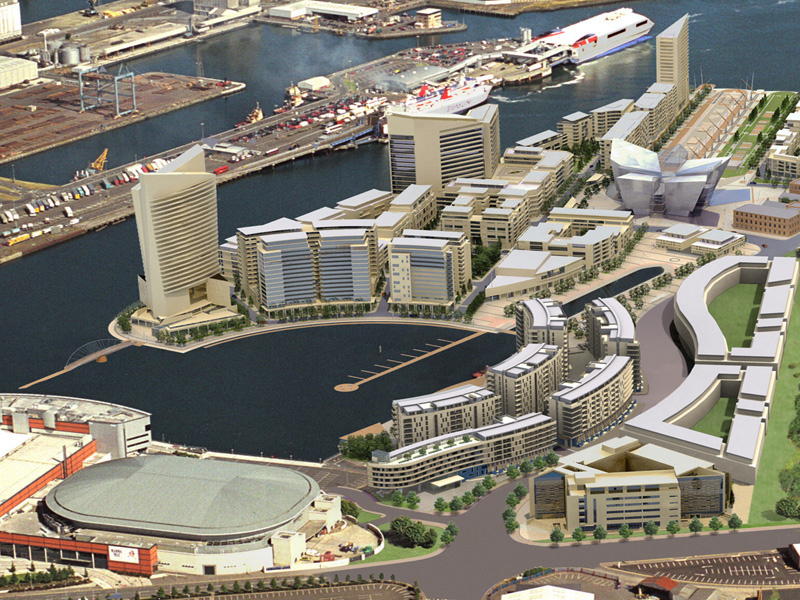
Newer waterfront construction was evident along the harborfront. Not sure what this non-descript building is, but much more dynamic building plans are in the works for the entire site, aptly named the "Titanic Quarter."
This was our view of the yard as we approached. Here we see the Sampson and Goliath famous twin gantry cranes in the distance. It is not widely known, but Harland & Wolff were initially considered for the construction of Cunard's replacement of QE2, Queen Mary 2. These cranes, with an 840 ton lifting capacity would have been used in her construction. Ultimately, they were not competitive with other yards and lost out to Chantiers de l'Atlantique in Saint Nazaire, France, making Queen Mary 2 the first Queen not built in the UK. One has to wonder if the British government could have stepped in and offered some sort of assistance, similar to what they did with the previous Queens, to make the deal to build the next Cunarder in the UK more financially attractive. The contract surely would have reinvigorated the entire area and I suspect the ship would be even more endeared in the UK, perhaps reinvigorating some sense of national pride. Sadly this was not to be.
Fortunately, the shipyard has been experiencing a resurgence, with renewed focus on renewable energy technology of wind and wave power as well as their offshore oil platform renewal and rehabilitation programs. For ship enthusiasts, though, this pales in comparison to a much smaller project, but with far more significance. Harland & Wolff have undertaken the restoration of the SS Nomadic, the last surviving White Star ship, who's significance is directly related to Titanic.
This little ship served as a tender to the Olympic and Titanic when the ship anchored in the port of Cherbourg, France. During our trip to Belfast in 2008, we saw the ship out of the water awaiting restoration in a fenced in area not far from where she was originally constructed in 1911. She had been rescued from the River Seine in Paris, where she had sat semi-neglected after her career as a floating restaurant ended with the closing of the restaurant. Read more about SS Nomadic's restoration here.
From the Titanic Quarter website: In an area steeped in history, Titanic Belfast (opening spring 2012) forms a central part of the development of Titanic Quarter. The state-of-the-art building, designed by leading international architects and designers, will include a ‘Titanic Experience' exhibition, an ‘immersive theatre' diving underwater to explore the wreck, a Titanic-themed banqueting suite and a community arts facility for local exhibitions, performances and conferences.
The project will also include the restoration of the Titanic and Olympic slipways, the Thompson Dock and Harland & Wolff's former Headquarters building.
Here is a rendering of the "signature" building scheduled to open in 2012, the Titanic Belfast. As part of the development, the Harland & Wolf headquarters building (the drawing room) will be restored and integrated into the redevelopment of the site. Now the question is what will be unveiled during the event on May 2nd in New York City? Stay tuned.
All development images courtesy of www.titanic-quarter.com
Stephen Payne recently spoke to students at the Webb Institute, a noted Naval Architecture school I had once considered attending, about the design of the Queen Mary 2. Below is a link to the video published by the school on YouTube. It is a facinating recollection of the design process and Stephen's passion for ocean liners from an early age.
Blue Peter is a name with little meaning to those on this side of the Atlantic or at least to me anyway. What is it? Sounds like it could be a bird. Maybe it’s some sort of exotic drink? I’ll take a Blue Peter….Or perhaps it’s some sort of medical condition afflicting only men. None of the above. It’s actually a children’s TV show from the UK and quite a famous one at that. It has the distinction of being longest running children's TV show in the world, having debuted way back in 1958! Despite this, I had absolutely no clue what it was, even as Captain Ian McNaught mentioned it to my son Ryan during an impromptu conversation we had with him on the pier head in Newcastle back in October of 2008.
In probably my most memorable conversation we had with QE2's final Master, Captain McNaught rather skillfully wove into the conversation he was having with my son on the fate of QE2, a story about QM2's designer, Stephen Payne and Blue Peter as mentioned in the above video. Without mincing words, my son had told Captain McNaught that he was a bit mad at Cunard while at the same time very sad to see the ship being retired, especially since she was the last great liner of the UK. He had only got to sail on her once and like his father, could not get his head around the fact that this piece of maritime history and cultural icon was being lost to the UK. History was indeed repeating itself again as all this was sounding eerily similar to the retirement of Queen Mary back in the 1960’s.
Ryan, unwittingly in the process of letting the captain know how he truly felt, gave me a sense of pride in that he was finally regurgitating all the things I had previously been telling him. But, I was also cringing as he was letting it all hang out, so to speak, and I did not know where this was all going. Was he going to spout off some of my thoughts about the crazy plans we were hearing at the time about removing the funnel or the fact that I really had no desire to go see her in Dubai, of all places? Please stay clear of how I felt about a piece of UK maritime heritage lost to an Arab country. This conversation could have gotten a bit ugly and embarrassing.
Our trip around the UK was QE2’s final farewell lap and everywhere we went, her significance to the people and culture of the UK was readily apparent. People came out in droves to see the ship in every port. We had already been to Greenock, then on to Clydebank, and we had just sadly seen all that was left of her once proud her birthplace at the Titan Crane. Ryan had heard it all from me before and for the past week, had been bombarded with all these facts and the grim reality that the end was near was setting in. He even saw his dad getting a bit choked up at the “funeral service” at Liverpool Cathedral. Now, it was apparent that all of this had been absorbed. I don’t even need to call it brainwashing since he saw it all for himself. Ryan really did get the significance of the ship now. Especially now that the cruise was about to end, he was letting the Captain know his true feelings as only a nine year old could. Captain McNaught, though, handled this situation masterfully, and would turn things around and leave him with words of inspiration.
As any good company man would do, McNaught convincingly offered up the Cunard marketing spin that QE2’s time had come and she was going to be off to a much needed retirement. You know, that “do not fret, she was going off to a nice warm climate for her retirement, to be well cared for by her new owners” mantra that was also given out when they retired the previous Queens. He went on to point out that there’s her replacement, the Queen Mary 2, the world’s only remaining liner, for us to continue enjoying along with the newer ships, including the newly announced Queen Elizabeth. “So while it is sad, enjoy her while you can as there will never be another like her.” Those last words are particularly true. While Queen Mary 2 is a true liner, she was NOT proudly built in the UK on the Clyde.
In retrospect, I’m guessing that McNaught probably has said this response so many times before that it had become second nature and that he might even actually have convinced himself it was true. Now, I was listening intently since Ryan knew all about these two other ships from me and the company I had kept onboard. I think he also knew what ship McNaught would be captaining next, but Ryan asked him anyway, perhaps hoping to hear that he would eventually command Queen Mary 2, a fitting assignment both of us thought to command the current Cunard Flagship. We were also biased since our next cruise with Cunard was most likely going to be on Queen Mary 2. With a somewhat subdued voice, we were informed he would be sharing command of the Queen Victoria as his next assignment, but he went on to tell us a bit about his take on newest Cunarder in typical McNaught fashion.
Comparisons, McNaught style followed. In his discussion, pointing out just how special QE2 was, he dropped this gem. He was moving on, from the oldest to the newest of the Cunard fleet, going from the fastest to the slowest and then the piece de resistance, from the most beautiful to……and then he stopped. You fill in the blank. Clearly, his love for the ship was shining through. These last few cruises and all the retirement events were getting the best of him and it was obvious that this was going to be a difficult transition to his new assignment. (Since he’s not with Cunard or even at sea anymore, I don’t think I’ll be getting him in any trouble now mentioning this.)
After expressing to Ryan how lucky he had been to have experienced the ship, he went to commend him on his interest in ships and to inquire what career he was interested in possibly pursuing, pointing out that he obviously was interested in the sea and ships. Ryan mentioned he wanted to design another liner, as beautiful as QE2. I think it was then that he mentioned that his son was following in his footsteps and inquired what I did. I mentioned that I was an Architect, but had also studied Naval Architecture and that was one reason why the ship was so dear to my heart as well. Now, I knew who Stephen Payne was, but Ryan was not quite up to speed on Queen Mary 2 facts (yet). McNaught then mentions to Ryan that a young boy had written in to a TV show and told them that he was going to design the next great liner to succeed QE2, which at the time, everyone said was going to be the LAST liner built. The boy was Stephen Payne and he followed his dream as he went on, remarkably, to design Queen Mary 2, to replace QE2, inferring to Ryan that he should pursue his dreams and never put any limitations on them.
After seeing Stephen Payne’s detailed explanation of the Blue Peter letter coming full circle, so nicely explained in the video, I am only further in awe of this remarkable achievement in fulfillment of his dream. This remarkable tale also further reinforces just how special QM2 is; taking me back to another special moment I had onboard QM2 last January. It was a sea day and I was standing in the photo gallery looking at a video playing on one of the monitors showing the ship’s christening by QEII.
I was half paying attention to the video, while my main focus was the impressive wave action going on right outside the windows. Moving along at a leisurely 22-23 knots through seas, with the ships bow pushing aside massive quantities of ocean, with the ever so slight ship movement was truly impressive. There was the familiar creaking, yet subdued from what we had come accustomed to on QE2, and the rush of water as the windows displayed the blue green sea. With camera in hand, I was shooting out of the windows between the racks of photos for sail, despite the sign saying photography was prohibited. I was shooting the sea, not the overpriced photos, and others were doing the same. I was hoping to catch a big wave and the washer machine effect, but the seas were just not cooperating. I could have stayed parked in this window seat for the remainder of the day. It was then when it truly hit home that I was onboard a ship worthy of the title of Flagship and replacement for QE2.
It's been over three years now since my last QE2 cruise and over a year has past since our first Queen Mary 2 cruise, yet watching the Stephen Payne video brought back such vivid memories instantly. Thank you Stephen Payne for fulfilling your dream and creating a worthy successor to QE2. I hope to be around to see her replacement in thirty two odd years, or even more dreamily, when another true sistership built someday. Will Ryan go further in pursuit of a career in Naval Architecture? That remains to be seen. If only I can get him away from his Xbox 360 and other distractions a 13 year old faces.
October 7, 2008, QE2 anchored off Queensferry, Scotland. This would be her final port call in Scotland and the last time the flag of Scotland would be flown from her foremast.
Here we see two icons of Scottish engineering, the QE2, built in Clydebank, Scotland, and the Forth Rail Bridge. The Forth Rail Bridge opened for service in 1890 and was the largest cantilever bridge in existence until 1917, while it remains the second largest to this day. This engineering feat had it's history in a previous rail bridge disaster, the Tay Bridge, designed by Thomas Bouch, who was also working on a design for a bridge to span the Firth of Forth. After the Tay Bridge famously failed, sending a complete train into a stormy sea with massive loss of life, the designer was fired and the design for the Forth Rail Bridge scrapped.
The Glasgow based company of Sir William Arrol and Company was hired to redesign the bridge. The result is a massively overbuilt structure built entirely of steel, the first of its kind. Sir William Arrol and Company are also famous for designing and building the Titan Crane, which was used to build the three great Queens as well as other famous ships such as the H.M.S. Hood.
Touching the hull for the last time.
QE2 as viewed from the tender.
Getting ready to leave.
Forth Rail Bridge at sunset from the bit beneath the bridge of QE2.
Two years ago today, QE2 left on the farewell lap of the UK. We were onboard and it was the perfect trip to say goodbye to the world's most famous ship. Here's a video of the Sailaway, compiled from the first video I took with the new Nikon D90 as well as stills. http://www.youtube.com/watch?v=f2wN788OLfs&feature=player_embedded#!




 All development images courtesy of www.titanic-quarter.com


 Posts
Posts