Full disclosure here: I am a fan of cruising on Costa Cruise Lines. We had three outstanding cruises over the years on board the Costa Victoria and Costa Magica. I have followed the series of events as they unfolded with the Costa Concordia with dispair and utter disbelief at what appeared to have transpired. My prayers go out to all affected by this tragedy. Credit must be given to the crew of the ship for safely evacuating as many as they did is such a short time and also for the inhabitants of Isola del Giglio who helped comfort the dazed 4200 passengers and crew that made it ashore.
While there has been alot of anger and peculation on how the evacuation was handled, I am sure that the procedure will be intensively studied to learn from this tragedy in the coming weeks. The following are a series of images I posted on my Facebook account since the tragic accident occurred.
Marine AIS tracking, missing some data, but showing the overall course of the ship.
As reported
here, with AIS data, it appears the ship attempted to navigate this treacherous passage! There were conflicting reports from other AIS sites, including the one I use all the time Marine AIS (first screen capture above), but their data had a huge gap from the time the ship was making over 15 knots to the time it was essentially stopped off the shore where it settled. I was a bit sceptical of the first site since it was in Turkish and required translation, but somehow they had access to missing data. Or was it all fabricated.....conspiracy theorists rejoice! Maybe in was a massive electronics blackout/power failure due to those pesky capacitors that some were adamant was the cause, in as much so as I was so adamant that this had to be operator error. So I attempted to test out the the hypothesis that the ship did attempt to make this passage. Using the Marine AIS site satellite view, with uses Google Earth, I crudely roughed in the size of the ship. Unfortunately the screen capture software I used did not allow me to draw the ship on an angle, but you get the picture above of just how close and utterly stupid a move like this would be.

As further pictures became available, the enormity of the damage became apparent. This posting, clipping a news wire photograph, was my attempt to decipher how that boulder became lodged in the side of the ship. It was clear that the ship caught on the top of an outcropping, probably causing the sideways movement as mentioned by the captain himself in his unbelievable interview after the incident.
Numerous discussions were taking place via Facebook and Cruisecritic regarding why the list to starboard and not to port, given the the enormity of the gash that was now clearly visible. I postulated along with others that the ship might have been unstable and due to the free surface effect of the water in the ship, when the captain appeared to turn the ship into port, the starboard list was triggered that ultimately lead to the roll over. I then began to wonder if there was damage, possibly even more severe than what we can see on the port side, buried beneath the water on the starboard side of the ship. Surely, it would have been quite possible that the ship bumped the rocks on both sides while attempting passage. With the ship 112 feet wide and the passage maybe 200 feet, it left little room for error, hence the title of this post.
Next,
underwater photos of the damage began to surface on the Internet. While it was hard to decipher what you are looking at, the railings can be seen and the damage looked much more significant than if the ship just rolled over and hit the shore/rocks at her final resting place, in my eyes anyway. This had to be unseen damage on the starboard side since the port side was out there in full view and obviously, the rails would not be underwater.
Later in the day, an
interview with the captain found its way on to YouTube, with the captain unbelievably answering questions by himself, without a lawyer present. He looks completely in shock and very nervous. Here is another video with analysis of his body movements. This was done before the person making the analysis knew that the captain had been arrested, which is very interesting.
Throughout the day, the initial death claims thankfully kept dropping as Costa began to account for the ships passengers and crew that understandably had gone off in many directions once they made landfall, making generating an accurate missing passenger list difficult. The island was overwhelmed with approximately 4200 people quite unexpectedly in the dark of the night. Logistics for Costa to get their passengers back to the mainland and safely home must have been a nightmare. How do you plan for such an event? I have to give the crew credit for safely evacuating that many people in such a short order, probably two hours, off the doomed ship.
Sadly, there are reports that the Captain Franceso Schettino was derelict in his duties, perhaps leaving the ship early and not sending out a Mayday call. Costa, shockingly, released the
statement above, confirming that the ship was too close to shore and that Costa safety protocols had not been followed. Clearly, Costa was throwing their captain under the bus...er..ship, with this statement. For the cruise line to come out so quickly and so forcefully against the captain, I speculated that they must have compelling evidence against him, or they are risking further defamation of character lawsuits.
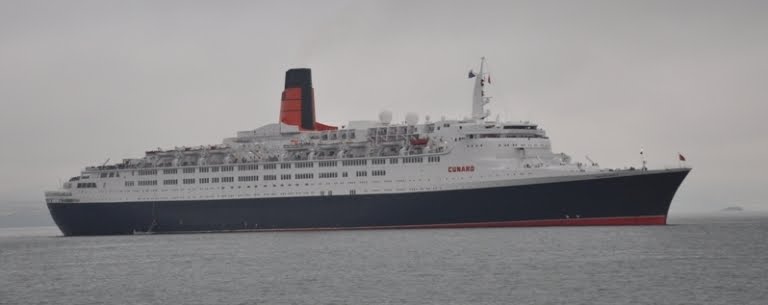
So what's the Cunard connection here for me? Besides my previous affection for Costa, these events have dragged Queen Mary into the discussion. Comparisons have also been made of QE2's famous grounding off Martha's Vineyard. Reporters, eagerly capitalized on Queen Mary's recent capacitor failure incident and to try to link it to this accident as written
here for example. Actually, the incident is over a year old, but only recently a fleet wide safety alert was issued alerting ship owners and operators of the issue.
Seeing the ship all lit up as it was close to shore, coupled with various reports of passengers explaining that the power only went out after the loud bangs and violent ship movement led me to conclude that there was no mechanical failure. Looking at the AIS telemetry, it was pretty damning that with either AIS track, the ship made a deliberate track towards the island and there was plenty of time to correct their course if it had been an inadvertent mistake in navigation. As the ship came dangerously close to shore, surely the officer on watch would have to have been aware of the ships position, possible lights from the island directly in front of them and perhaps, one would hope, there were numerous alarms going off. Perhaps this added to confusion on the bridge. All this will come out in the days ahead.
Late this evening, a poster on Cruisecritic posted yet another series of AIS tracking screen shots
here, one of which is shown above, showing exactly what the Turkish site had initially posted. Pretty damn convincing evidence if this is actual data, but not if if only a simulator. Costa Concordia approached the passage at 8 knots!? Absolutely no margin for error and totally reckless and irresponsible on the captain's part to even attempt this. Let's see if this is for real or not!
I am eagerly awaiting further pictures of where the ship attempted to squeeze through to definitively answer this question. Surely the rock outcroppings will show damage, displacement, and the ship's paint. Divers eventually found the rock outcropping that QE2 scrapped her way over, covered with red antifouling paint, matched to her hull. That rock now bears the name "Queen's Bottom." What will this area be renamed as, the Schettino Passage?


 Posts
Posts