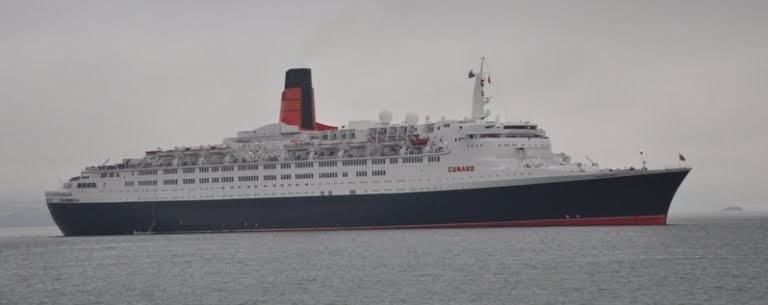
The legendary Cunard Queen Elizabeth 2 on the Hudson River in New York City, October 16, 2008, as she departs for the final time.


09 August, 2011

Liner Bows

People ask me "Why the fascination in QE2 and her replacement QM2?"  My response is always because both are true ocean liners and there is nothing quite like traveling at speed through less than idea seas.  It is both exhilarating and reassuring that you are on board a ship that can handle the toughest weather that can be thrown at her.  Those comments inevitably launch into a discussion of ocean liners and their differences from the typical cruise ship of today and that often used phrase "form follows function."  It really does apply here. 


Ocean liners are ships traditionally purposely designed to ferry passengers on a specific route or a "line" on a schedule.  The traditional "line" crossing of the Atlantic required a ship with speed to make the crossing under five days, at the highpoint of this type of travel to and from Europe, and to make this crossing safely,on time, and with consistency, despite the weather and sea conditions.  Before the arrival of the Boeing 707, this was the main way to get to Europe and the ships could be regarded as very large and elegant ferries, depending on your class of cabin.  Nowadays, cruise ships are used mostly as "the" destination and not as a pure form of transportation to get to a destination.

Oddly enough, though, QE2 was designed to function as both North Atlantic ferry and cruise ship.  In fact, when the ship was introduced, there was a conscious effort put forth in the advertising that the ship itself was the destination.  This turned out to be the case throughout her service life. 

To this date, Cunard effectively uses this strategy with their current ships, the true ocean liner Queen Mary 2 and the cruise ships Queen Victoria and Queen Elizabeth.  Both of these ships are designed for the cruising mode, at reduced speeds, which is reflected in more fuller bow sections, which give more interior space, with the resulting less efficient hull form.


Now, the North Atlantic can be notoriously rough certain times of the year, usually from late Autumn to early Spring.  Ships built for this application require strengthened hulls to take the constant strains imposed upon them all the while at the high speeds necessary to keep to their published schedules.  These design constraints dictated slender bow sections to efficiently slice through the seas, bow profiles to deflect the seas in all conditions, and big powerplants to drive these ships at speeds averaging over 28 knots.  Even with this speed, there had to be extra reserve speed available to make up time when bad weather was encountered.  As illustrated in the photo above, QE2's bow configuration was designed for speed and seaworthiness.  In fact, this hull design was one of the first passenger ships modeled with the earliest computer aided design back in the early 1960's.  This hull form was so successful that when the time came to design her replacement, Queen Mary 2, her bow sections were basically lifted right from QE2.  According to her Naval Architect, Stephen Payne, even with all the most sophisticated modeling software available today, they ended up with a scaled up version of QE2's bow, but with a more efficient bulbous bow design.  In the end, why mess with success!

This head on bow shot of the Carnival Miracle shows the difference in bow designs and is the basic hull design that the Cunard Queen Victoria/Elizabeth sisterships has evolved from.  Not that there is anything wrong with this ship in my eyes, mind you, but as form follows function, this ship is designed for cruising speeds maximum of about 22 knots, and must slow considerable when encountering rough seas. 

I am eagerly anticipating another winter crossing on a liner, Queen Mary 2, in January, and hope to see first hand how she handles the North Atlantic like QE2 and her predecessors.

04 August, 2011

Queen Mary 2 in Manhattan

July 1st was a special day in New York City for ocean liner enthusiasts and fans of Cunard Line's Queen Mary 2.  Nowadays, the ship docks at the new cruise ship pier in Brooklyn, but this day, another Carnival owned ship, the Caribbean Princess, which uses the Brooklyn pier exclusively, was also scheduled to be in port.  Queen Mary 2 would be "forced"to dock once again at the Manhattan Cruise Ship terminal, the piers she was originally specifically designed for and the same piers used by her predecessors, Queen Mary, Queen Elizabeth, and most recently Queen Elizabeth 2.  For traditionalists, and many former QE2 passengers accustomed to the traditional Manhattan pier, this pier change was a very special treat.

Having made this trek up the Hudson on QE2 back in January of 2008, I can attest this is definitely the best way to arrive in New York City, treated to the beacon of the Statue of Liberty in the early morning on the portside and the entire Manhattan skyline on the starboard side.  This time I would be standing on the renovated Pier 86 in shorts and a polo shirt rather than standing beneath the bridge of QE2, all bundled up and trying to keep my finger on the camera shutter from frostbite.  The weather was picture perfect.  As QM2 appeared in the distance, the morning sun appeared and lit up the ship rather theatrically, highlighting the iconic funnel.  Although QM2 is demonstrably larger than QE2, the ship she replaced, she is every much a liner and a standout amongst the current batch of cruise ship resembling stacks of apartment flats.

In the early morning sun, it was apparent that the ship has suffered some hull damage, in the awkward area of the stern required for the pod propulsion units.  More than likely it was a bump to a pier.  Didn't she make headlines with a mishap at some port in Europe?  The ship is scheduled for drydocking this fall and it clear that she's due for some refurbishment;  antifouling paint is very worn and the hull is in need of repainting.

Queen Mary 2 docked at Pier 88, originally the French Line pier where the Normandie tragically caught on fire during its conversion to troop ship during WWII.  Attempts to extinguish the fire added water to the hull that eventually led to the ship rolling over in the pier and sinking.  With the ship a loss, it sat for much of the war in the pier, as a sad reminder of the war. Carnival Miracle would arrive and quickly dock on the opposite of QM2 at the pier and I was treated to a nice view of several tails; the French built Queen Mary 2, Finnish built Carnival Miracle, British built Concorde SST, and American built  U.S.S. Intrepid.

Before meeting up with ocean liner friends (some getting off QM2, others joining the ship this day for the traditional Fourth of July cruise), I planned to walk the entire waterfront from the Cruise Terminal down to Battery Park and take advantage of the picture perfect weather.  While I would end up seeing such maritime relics such as the Lightship Frying Pan and the fireboat John J. Harvey, my main goal was to get an up close view of the once glorious Cunard Line Pier 54 of the Chelsea Piers.  I've seen it from the water, having it's historic nature pointed out to us on the decks of QE2 and Circle Line excursion boats. 

On the rusted ironwork face, you can still make out both names, the original Cunard Line, and then the subsequent Cunard White Star name of the merger of the two lines which resulted in the completion of the original Queen Mary.

All that most visibly remains is the ironwork arch of the head house and the stone base, which looks like it was fashioned from Stony Creek Granite, from the Stony Creek Quarries of Connecticut that I previously visited through work.  Peering through the fence though, were bits and pieces of the terminal strewn about, including the art deco inspired stone pieces depicted above, a very sad sight.  One can only image what this pier was like in it's heyday.  Sadly this  historic structure, designed by the architects of Grand Central Station, did not escape the wrecking ball.  It was here that the Lusitania sailed for her final time and also where the Cunard Line's Carpathia offloaded survivors of the ill-fated Titanic.

Following lunch, fellow ocean liner enthusiasts and I debated where would the best spot be to see Queen Mary 2 depart.  We would end up taking the New York Watertaxi over to Weehawken, NJ, for the best view of the ships departing that afternoon.  Perched above the access road above the cliffs across from the Cruise Ship Terminal,  it was readily apparent that this was a good decision.

Queen Mary 2 departed on time in the afternoon sun, with short blasts from her original Queen Mary Tyfon horn, which sounded remarkably improved over the last time we heard it while onboard.  She looked ever the part of a classic ocean liner in profile against the Manhattan skyline.

Cunard Line has used several of my pictures in a recent blog post of Cunard President Peter Shanks.

Just above the bow of QM2, the Freedom Tower can be seen rising above the lower Manhattan skyline.  I'll no doubt be back next year, same date, same cruise, and hopefully in Manhattan again (please Cunard make this happen).  Who knows, maybe I'll be onboard.............

27 May, 2011

75th Anniversary of Queen Mary Maiden Voyage

On May 27th , 1936, Cunard-White Star Line's Queen Mary began her maiden voyage from Southampton to New York City.  Here is original footage of her arrival in New York.  Here is better Newsreel footage.

(Sorry, but I cannot locate where I obtained these photos from on the internet to give proper credit and a link.  If anyone knows, please send me the link.)

15 May, 2011

QE2 Ringtone for iPhones

I've finally ditched the old flip phone, which I could not customize the ringtones. With my new iPhone 4 in hand, I now wanted to customize the ringtone to something reminding me of QE2.  At first, it looked like it could be somewhat complicated, after doing a quick search of "how to's" with Google.  Thankfully, though, I have found there is no need to download any fancy apps or software to do this.  If you have iTunes loaded on your home computer, this is super easy. This procedure is for the iPhone, which use iTunes for music files.

First, download this mp3 file, which was offered originally on the day of QE2's final departure from Southampton:
http://www.dailyecho.co.uk/news/3842159.Get.QE2_s.whistle.as.a.free.ringtone.for.your.phone/

Note:  you do not have to use this file if you have another MP3 file of QE2's Tyfon horns to choose from.  I certainly do, but this clip is perfect; perfect sound, with no wind and crystal clear sounding.

Second, follow these easy instructions for converting the MP3 file to an M4A file and then renaming to a M4R file that the iPhone recognizes as a ringtone.
http://www.pcworld.com/article/156234/turn_any_mp3_into_an_iphone_ringtone.html

Third, with M4R created and in you iTunes account, connect iPhone to computer and sync phone.  Go to your ringtone settings and the QE2 file should be there to chose from and reset.  Voila!  Done!

Getting phone calls now puts a big grin on my face.  I just discovered another cool thing the other day with the iPhone.  Listening to the iPod feature, I got a call, and the QE2 ringtone played over the song on my headphones.  At first, I was completely caught off guard when I heard it, but then realized I had an incoming call.....cool!

25 March, 2011

The Shape of Things to Come, Part 2

Yes, this is a cruise ship and not a apartment block on the water's edge.  It's NCL's Epic, as I caught a glimpse of her in Manhattan on the day of her maiden port of call to New York City.

What is going on with the hull at the stern, which looks like it's sprouted a ducktail-like appendage?  This hull feature clearly has a function since it cannot be said that it was added to enhance the beauty of the ship.  Perhaps it was necessary for the hull hydrodynamics for pod propulsion.  Wait a minute, this ship does NOT use pods for propulsion.  Despite being built at the same yard as Queen Mary 2 and is about the same size, conventional shafts and propellers are used. 

So what is going on here?  Surely, the yard is not shying away from pod propulsion based solely on the problems that have been experienced on Queen Mary 2 and other Celebrity ships that utilized the Rolls-Royce Mermaid pod design.  I'm guessing it has got to be to increase the waterline, increasing hull speed, which, in effect, would allow the ship to use less fuel.

Actually, it seems like we're seeing a trend developing here in cruise ship design and it is not a "pod" thing after all.  More evidence here from the stern of the P&O Azura, which sprouted one of these similar appendages.  We saw this ship in Barbados while on our Queen Mary 2 Caribbean Calypso cruise this past January.  This ship is based on a proven Princess Cruise Lines Grand Class design;  you know the ones with the weird handle bar or spoiler attached high above on the stern.  Azura, thankfully, was built without it, and this feature is scheduled to be removed from other similar ships in the fleet.  Apparently, this feature was just not working for the line.  Perhaps those passengers deserted the aptly named Skywalkers nightclub located in the "spoiler" when the seas were anything but smooth.  Anyway, I digress.  Azura is NOT pod propelled , but has conventional shafts and props with thrusters mounted in the keel area for unassisted tug manuevering.  The appendage shown here has slight pockets in it for the propellers, which can be seen in the uneven dark area at the waterline.

Construction photo of the Azura, showing the keel mounted stern thrusters and conventional shaft and prop propulsion.  Photo was found on the Cruiselinefans board here


Back to another example of this new trend.  Here is the stern of NCL's Jewel, taken from a Circle Line excursion boat on the Hudson in October 2009.  Now this ship does have pods; the ABB Azipod design, similar units used on the Vista Class twins Queen Elizabeth and Queen Victoria.  The appendage is nicely integrated into the hull here and while not a fan of all the hull graphics, I am not offended by the design, unlike the massive NCL Epic.  From this angle, it looks like the appendage will act like similar to trim tabs used on smaller boats.  In fact, if you study the hull design of QV/QE and her other sisterships, you can see a less pronounced duck tail appendage in the squared off sterns.

Taken on October 16, 2008, while watching the final departure of QE2 from New York, the Carnival Miracle is one of the first Vista Class type hulls in the vast Carnival fleet.  Technically it is classified as a Spirit Class ship and is the precurser to the current Vista Class ships.  This ducktail appendage appears less integrated into the hull design as in the latest iterations on the QE/QV twins, HAL's Eurodam and Niew Amsterdam, and the latest from Costa.  Carnival is clearly getting alot of their money's worth out of this hull design.  On the Miracle, it really does look like this "stern flap" was added after the fact.  Look at the corners where there appears to be a pipe guard for additional pod protection.

For Cunard's most current ship, here we have Queen Elizabeth, navigating the locks of the Panama Canal for the first time, courtesy of http://www.wearecunard.com/.  The stern flap is now seamlessly integrated into the modified Vista Class hull.  From this angle, you can see the added cabins at the stern, resulting in a less rakish profile as compared to the Miracle above.

While this energy saving appendage is subtle here on the Elizabeth, the stern flap appendage appears to have been taken to the extreme on the new Celebrity Solstice class ships.  I'll go out on a limb here and say that I rather like the outward appearance of these Celebrity ships, from the distinctive shear profile, sleek bridge wing design, distinctive sloped stern profile, and even the blunt nose bow shape.  I could do with less of the dark tinted glass, but I liked the design from the day I saw the artist's renderings posted online.

 Delving into the design of this new class of ship for Celebrity, I found a very interesting article explaining all the unique aspects of the ship and the class found here. 
Note: all photos of the Solstice here are courtesy of www.meyerwerft.com/

As explained in the above article, an extension of the hull, the extended ducktail, resulted in a sleeker hull and less resistance.  Extensive tank testing was done at Marin in the Netherlands, who were used for Queen Mary 2 development, to optimize the hull form. 


In addition to the ducktail, there is another feature, not readily apparent underneath the tail called an interceptor.  In this case, it was found that a wedge shaped interceptor proved most efficient in decreasing the amount of power required to drive the hull.  More information on hull interceptors can be found here.

I've yet to find any really good pictures of this feature, but there is a picture in the Solstice PDF file referenced above that hints at the appendage under the ducktail.  You just have to commend the Naval Architects and Celebrity for trying out this new technology.  Up close, the tail does look a bit weird to the eye accustomed to more conventional shaped sterns and especially from the air, it really does take on the shape of a ducktail.

Additional measures to reduce fuel consumption included grinding all the hull welds smooth and using the latest state of the art antifouling paint coatings.  Cunard has similarily been using this improved coating on its fleet with success.  While these contribute to the increased fuel efficiency, the second most readily apparent feature on the new Solstice class is the extended bulbous bow.

Piercing the water in the preceeding bow shot of the Solstice, is a bulbous bow, which appears to take this appendage to the extreme as well.  It could very well be the longest bulbous bow fitted on a cruise ship. Unbelievably, it appears to extend to at least the length of the blunt nosed bow.  At first I thought this photo below was distorted due to the camera angle, but the above mentioned article explains that the appendage was indeed lengthened for speed.

The Meyer-Werft shipyard design appears different than the extended bulbous bow on Queen Mary 2 in that the cross section is much thinner, less round in appearance.

 Queen Mary 2's appendage was lengthened during the design process after tank testing did not produce the hull speed specified by Cunard.  As Naval Architect Stephen Payne has mentioned, there are compromised with extending the bulbous bow appendage to increase speed.  "Bulb slap" is probably the worse consequence, which occurs when the appendage comes crashing down into heavy seas first, since it is so forward of the bow and sending shudders throughout the ship.  QE/QV experience this "wiggle" in heavy seas from what I have read and heard from passengers, but Queen Mary 2 is not immune to this as well.  Further discussion on bulbous bows and the eternal cruise ship vs. ocean liner debate can be found here on my favorite forum for discussing all things QE2,  http://www.theqe2story.com/.

Queen Victoria's bulbous bow in drydock, courtesy www.wearecunard.com

Who knows how the Solstice ships fare in heavy seas, with their more slender bow-like shape.  The interiors of this class of ship are trend setting modern design, much like QE2 was in her time.  In the novelty department, the Solstice has a Owens-Corning glass blowing feature and an industry first; real grass on the sports deck.  One day, I intend to try out both inovative features first hand. 

Jumping on the ducktail bandwagon, Princess Cruises just announded their new Royal Princess cruise ship.  At first, I thought that this ship had to have been designed by the Meyer-Werft yard since it resembled the Solstice Class of ships and even included the bridge projection that the yard is famous for on other ships for Aida and NCL.  Note: all photos courtesy of Princess Cruises.

The stern flap is readily apparent in this rendering, but this ship is surprisingly going to be built by Fincantieri, which has a long standing relationship with Carnival Corporation.  Most recently, Fincantieri has delivered the QV/QE sisters for Cunard for instance and were the builder for the Carnival Splendor, which made the news recently for the dramatic engine room fire and days spent adrift at sea.

As always, you have to follow the money.  Shipbuilders and owners are driven financially by the almighty bottom line.  Apparently, the cruise ship industry has followed the United States Navy in their quest for fuel savings.  I found this paper online, which goes into detail on the "stern flap" technology.  If you're interested in what your tax dollars funded, read on.  http://www.dt.navy.mil/pao/excerpts%20pages/2001/sternFlap9_01.html

For further technical reading on combining both stern flaps and hull interceptors, take a look at this paper.  For further technical reading on stern flaps, take a look here.

All this research has brought back those college memories of brain overload with the sleep robbing Architectural Design Studio and the brain frying mathematics of Naval Architecture classes running concurently.

18 March, 2011

The Aft Deck

QE2's aft deck, final call at Liverpool, October 2008 

QM2's aft deck, morning on the Caribbean Sea, January 2011

What's missing from QM2's pic is the guy with the pint out in the sun on QE2.  Mind you we had not fully docked yet at the pierhead in Liverpool in that photo and most folk were at the rail watching the ship approach the pier, he was getting some sun and enjoying his beer.  This apparently was his favorite spot since I inadvertently captured him in a similar pose on yet another day! 

The chairs on QM2 are plastic coated metal with mesh fabric, while QE2's were all PVC plastic with cushions. Somehow, though, I think this guy would feel right at home on the aft deck of QM2.


12 March, 2011

Queen Mary 2 Sunrises & Sunsets

To take your mind off the recent events in Japan, where Queen Mary 2 is currently safe and sound, sailing on her World Cruise, here is a compilation of sunrises and sunsets taken while on the Caribbean Calypso cruise this January.  Although I missed the first morning's sunrise, sleeping in after a few long nights of packing for the trip, I set the alarm and got up for every other sunrise.  It was completely worth it.  Taken with my Nikon D90, bought last minute for the QE2 Farewell to the UK cruise, these photos are just a few of the over 5000 pictures I took.  The Nikon was on my shoulder most of the trip and  it really makes the person behind the lense look like a pro!

The "bit beneath the bridge" was the spot to be at sunrise for most of the trip, until we changed direction and headed back home.  Every morning, I shared this spot with another fellow photographer that I had met back in New York before we even boarded the ship.  We met taking bow shots at the Red Hook terminal, with a common interest; photography of a great ocean liner. He was German and spoke little English, but we exchanged a few words each morning as we were awestruck with our combination of great weather and ship.  You can actually spot him in the video of the bridge shots while we approach Dominica.  Don't ask me why, but we did not exchange email addresses.

Enjoy!  http://www.youtube.com/watch?v=h_pqk_Iewzs