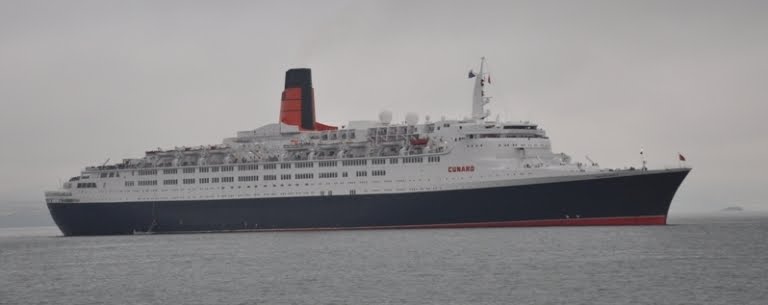
The legendary Cunard Queen Elizabeth 2 on the Hudson River in New York City, October 16, 2008, as she departs for the final time.


27 April, 2010

QE2 Webcam Found


Thanks to "Dubai Guy" posting on my favorite website for finding this cam. 
http://www.theqe2story.com/forum/index.php/topic,1912.0.html
This is a high resolution cam and if you save the image as mentioned in the forum post, you can zoom in and get a decent idea of our ship is doing in Dubai. 

While not the bridge cam that I used to have open and minimized to a corner of my desktop to see where QE2 was on any given day, this Port Rashid harbor cam is the next best thing.  How sad it is though to see her sitting there idle, baking in the hot sun.

11 April, 2010

Pride of the Clyde

When researching names for this blog, I found it difficult to come up with a unique name that had not already been taken. With the popularity of QE2, it is not amazing that there are a multitude of websites devoted to the ship.  I ultimately settled on "QE2 - Pride of the Clyde."  Unfortunately, a Goggle search found a Coach for hire company in Greenock using "Pride of the Clyde " already.  So much for my unique name.  Since I liked the ring to this name, I figured a way around this, which in theory, might add traffic to the site by adding "QE2" to the name.  Now I was ready to launch my new blog, thinking I had a somewhat unique name to capture my obsession, the pride of Scotland, and to honor the workers who built the last ocean liner in the UK.

The blog was started long after QE2 had made her trip to Dubai.  I had taken one of the final voyages, a very special one that had been shoehorned into the schedule once the announcement had been made that the ship had been sold to Dubai.  This voyage was billed by Cunard as the "Farewell to the UK" voyage and this would be a lap of honor for the ship around the UK.  When I saw the itinery, I knew the Greenock port of call would be special as this was the closest QE2 would return to where she was built.  Unbelievably, the weather was absolutely perfect for our arrival, with an escort my the HMS Manchester.  People were lining the waterfront as we arrived, along with our flotilla of small craft that accompanied us up the Firth of Clyde and eventually into Greenock.  My initial perceptions of Greenock were spot on.

The photo above was taken along the Esplanade, with the docks in the background.  QE2 had obviously not yet arrived, but as the photo shows, there was quite a turnout for QE2's final homecoming of sorts.  We unfortunately never got to see this display and it wasn't until months later did I find photos posted of this tribute.  Once the ship docked, we eventually got off and took a Cunard shore excursion to Glasgow to see the Transport Museum, which has a vast collection of shipbuilders models, but the main reason why we took this excursion was to visit the site of the former John Brown Shipyard to see QE2's birthplace.  I knew that there wasn't much left, but I was still shocked to see utter distruction.  Basically,  the only thing left is the Titan Crane as discussed in the previous post. 

This special day was full of a wide range of emotions.  For us, there was the initial excitement on the approach to Greenoch, seeing Scotland from the sea for the very first time.  Then, there was the feeling that we were experiencing something very historic.  It is not everyday that a non-military ship gets a naval escort into the pier.  The sense of pride was palpable.  People were lining the streets to see the ship all day.  After the euphoria of our arrival, seeing the remains of the John Brown yard later in the day brought the complete opposite emotion of incredible sadness. 

So many countless times I have heard that QE2 was the last great ship built in Scotland, but on this day, there was no escaping why this ship is extremely special, much beloved by so many, and the "Pride of the Clyde."  The once great yard that built her is gone along with industry that the Clyde was famous for.  At the peak of the shipbuilding industry in the UK, "Clydebuilt" meant the finest in shipbuilding, known worldwide.  The opinion voiced by our Titan Crane tour guide as well as everyone onboard QE2 was that the UK was about to loose their finest example of Scottish shipbuilding,craftsmanship, and engineering to Dubai in a few weeks time. The end was coming all too quickly.  QE2 would depart Greenock for the final time later that evening, with a spectacular fireworks send off and not a dry eye in sight. 

For me, though, the planner in me has kept thinking that there is a lost opportunity and by far a more suitible place for QE2 to be in her retirement.  The fitting out basin is empty, awaiting her return............
The John Brown Shipyard fitting out basin, with the red brick lined notch in the bulkhead, modified to accommodate the first two Queens in the background.  In the foreground, the bollards that QE2 and countless other great ships were tied up to during their fitout. 

08 April, 2010

Clydebank Rebuilt


This is the former Fitting Out Basin of the John Brown Shipyard.  In the background are mounds of  building demolition debris and the newly built Clydebank College.  This is the site where the great ocean liners Lusitania, Queen Mary, Queen Elizabeth, and Queen Elizabeth 2 were completed as well as many naval warships such as the HMS Hood.  Sadly, QE2 would end up being the last passenger ship built in Scotland, the "Pride of the Clyde."  The John Brown Shipyard, in a last ditched effort to stay afloat during the construction of QE2, merged with other yards on the Clyde into Upper Clyde Shipbuilders (UCS).  UCS was later aquired by Trafalgar House , one time owners of QE2, then later acquired by Marathon Oil for oil rig repairing, which saw this industry declining on the North Sea and finally closed its doors for good in 2001.  The site was later completely demolished, save for the Titan Crane, which has been restored and is now open as a unique tourist attraction.

The Titan Crane is the only "A Listed" historic structure in all of Clydebank and stands silently as the sole reminder of the vast shipyard that once existed on this site.  Standing 150 feet tall, and with a 240 foot length of the cantilever, the crane was capable of lifting an astounding 200 tons.  The great gun turrets of the HMS Hood were lifted in place with this crane.  During World War II, Clydebank was targeted by the Germans due to the strategic importance of the shipyards.  Clydebank was the most heavily bombed city in all of Scotland during the war, but miraculously, the Titan Crane was never hit.  Fully restored and open now to the public via a new elevator, the views of the Clyde are breathtaking.

This view, looking down the Clyde towards the Erskine Bridge, shows both the beauty of the Clyde and the devastating remains of the building demolition of the site.  Clydebank Rebuilt has a master plan in place, covering redevelopment of the Clyde.  This short video offers a glimpse of the future for the area.  This video gives a glimpse of the past. For added context, this excellent series of videos document employment in Clydebank, the decline of shipbuilding, and the social changes.

Recently, a new mixed income housing development opened, but vast areas lay open.  Three minutes into the first linked video above, there is a view of the Fitting Out Basin as seen from the Clyde.  What I see missing from that view is the last great ship built on the Clyde and fitted out in that very basin, Queen Elizabeth 2.  Could she return?  There are obstacles such as the Erskine Bridge, which would require temporary removal of her Funnel and Forward Mast.  She could be THE centerpiece for redevelopment of the area.  Here is a Google Earth flyover of the area, which was obviouly taken before all of the buildings were demolished or the new College built.

Currently, QE2 sits in Dubai, fortunately being well cared for, while her ultimate fate is unknown.  Bring the Queen back home!

28 March, 2010

So Far From the Clyde


Mark Knopfler, lead singer and guitarist from the legendary band Dire Straights has a new solo album, themed about blue collar life in the Highlands of Scotland.  This haunting song is one of his best and is a reminder to all of what COULD happen to QE2 someday. 

Mark is no stranger to writing music befitting life in Scotland.  He composed the soundtrack to "Local Hero,"  a cult classic movie about a Scottish fishing village about to be developed into a oil refinery for the North Sea.  "Going Home" is my favorite instrumental track on the soundtrack and was previously featured on my YouTube posting of the same name.  According to Mark's website, he spend time in Glasgow until he was eight, and then moved to Newcastle on the Tyne.  Obviously, he has expressed his deep affection for Scotland in his music.  I suspect he is watching what is happening to QE2, the last great ship built on the Clyde and would NOT want her beached in Alang.   


RMS Titanic Exhibit


The RMS Titanic, Inc., the organization that recovered artifacts from the Titanic wreck site has several traveling exhibitions.  We visited the exhibition that is currently in our area at Foxwoods Casino.  I had seen this exhibit back in 1999 while in Las Vegas, but Ryan had not.  Unfortunately, this exhibit pales in comparison to the much larger version in Las Vegas at the Luxor.  For instance, missing was the large piece of the hull that was recovered and well as a great deal of the artifacts.  Photography was not allowed.  One unique display, which we were told had never been on display, were samples of the hull rivits, which have been analyized and found to have contributed to the sinkings since they were formed with inferior steel.  This finding has been recently reported and had these rivits been sufficiently strong, the hull breaching probably would have been minimized and the ship may have been able to remain afloat.  Testing procedures for steel had not yet been standardized at the time of construction.

As you enter the exhibit, you are given boarding passes of actual passengers.  At the end of the exhibit, there is a display listing all of the passengers, by class, and you can look up your name to see if you survived.  Graphically, it was easy to see if you were in Third Class, you were unlikely to have survived.  Our passengers assigned to us were Archibald Gracie and Paul Chevre.


One interesting exhibit was a refrigerated block of ice, recreating an iceberg.  You could go up to it and touch it.  The guide mentioned that the seawater was actually a few degrees colder than the sample iceberg and that almost all of the passengers that entered the water died from hypothermia.  Another interesting exhibit, towards the end of the tour, were samples of perfume bottles.  The showcase had openings in the plexiglass and you could still smell the scent of the perfume.  As we made it to the final passenger list display, we found out that both of us had survived!  Exiting the exhibit, you enter the gift shop, which had a nice collection of Titanic books, samples of actual coal recovered from the ship, posters, shirts, and replicas of crockery used onboard Titanic.

We would recommend going to the exhibit, but spend the extra five dollars and take the audio commentary, which adds so much more to the experience.  The exhibit left me wanting to see more, but then again, I had seen the more complete version before.  It truly is remarkable to see how well preserved the recovered artifacts on display are in.  It is also a bit morbid to see the clothes and personal effects of the passengers, which is a grim reminder of the grave loss of life that occured on April 15, 1912.  The loss of the Titanic resulted in the creation of ice patrols and Safety of Life at Sea (SOLAS) regulations which affect construction and operation of all passenger ships to this day.

19 February, 2010

Launching of Q4

Here's my latest eBay purchase, the Launching Day Cover of the the new Cunarder "Q4."  What I find interesting with this postcard is the "Q4" logo above the ship and also in the stamp cancellation.  At the time this was printed, the ship's name had not yet been revealed, although there had been much speculation. 

The "Q4" designation was the internal name of the project by Cunard, the latest in a series of ocean liner designs.  "Q1" was the designation for Queen Mary.  "Q2" was Queen Elizabeth.  "Q3" was the design for the replacement of the first two Queens.  As seen in the internal Cunard rendering below, many of the "Q3" design features found there way into the smaller "Q4" design.

Rendering of Cunard's "Q3" design as depicted in Carol Thatcher's book :"QE2:  Forty Years Famous"

This design was later scrapped, not to be built, in favor of a smaller ship, more versatile ship with the ability to traverse the Panama Canal and do cruising during the off season from the traditional Transatlantic Crossings.  For further discussion on what can now be realistically viewed as a rather ill conceived design that probably would have spelled the end of Cunard, see the discussion here.

Harland and Wolf "Q4" proposal rendering dated November 27, 1964

Cunard revised their design and solicited proposals from several yards including Harland and Wolff, builders of Titanic, and John Brown.  The above rendering was offered for sale on an auction house awhile back and offers a unique view of what may have been.  According to the description, this rendering is dated November 27, 1964, two days before the tender for the "Q4" design was due in to Cunard.  The funnel depicted looks remarkably like the Sagafjord and Vistafjord ships which would later be acquired by Cunard.

The revised ship, with the design untimately awarded to John Brown Shipyard of Clydeback, Scotland was named  "Queen Elizabeth the Second, "infamously on launching day, September 20, 1967 by Queen Elizabeth II and would eventually become the most famous, most traveled ship in the world. 

So how did the unique "2" come to be?  Apparently, according to various sources, the Queen never opened the envelope, which had only the name "Queen Elizabeth" printed on it for the naming ceremony.  Cunard's intention was to name the ship after the first Elizabeth, their common ship naming practice, so technically, as the Queen pronounced, she was Queen Elizabeth the second.  Some would argue, though, that she named the ship after herself!  This left Cunard in a predicament.  They could not name the ship Queen Elizabeth II without angering the Scots who built her, since Scotland did not recognize the first Queen Elizabeth I.  Common folklore is that Cunard came up with the idea to use the Arabic "2" instead of the Roman numeral "II" to get them out of this somewhat sticky situation.  Perhaps this is true, but the true facts may never be known if the Queen takes the real story with her to her grave.  Read more about the naming controversy here.

17 February, 2010

Clydebank Redevelopment

Rendering of the fitting out basin courtesy of http://www.clydebankrebuilt.co.uk/

What is missing from this rendering of proposed redevelopment of the former John Brown Shipyard?  Could it be that there is absolutely no reference to the proud shipbuilding heritage of this site?  Even the arctitecture is pretty nondiscript and could be seen just about anywhere in Europe.  This is the fitting out basin, where many famous ships were completed such as the HMS Hood, Queen Mary, Queen Elizabeth, Queen Elizabeth 2, and the royal yacht Britiannia.  All that remains of the once great John Brown Shipyard is the Titan Crane, now fully restored and open as a tourist attraction, and this fitting out basin.  The slipway is gone, replaced with a community college, but the guides still remain at the waters edge and the designers have outlined the location of the slipway in the treatment of landscaping.


Queen Elizabeth 2, on her launching day, September 20, 1967, being towed into the fitting out basin with the Titan Crane at her bow.

While on QE2's Farewell to the UK cruise, we stopped in Greenock and took an excursion dubbed the "Cunard Heritage Trail", which included a motorcoach ride along the Clyde from Greenock to the Transport museum in Glasgow, followed up with a visit to the former John Brown Shipyard and the restored Titan Crane.  What immediately struck me was the beauty of the Clyde at Clydebank, in particular, but nothing prepared me for the utter destruction I saw of the shipyard.  Nothing remains of the buildings but piles of rubble and steel columns cut off at their bases.  We stood along the fitting out basin after our tour of the Titan Crane and even sat on the bollards that the great ships constructed here were moored to in the basin.  The tour guide even pointed out the modification to the pier, done in brick, to accommodate the first two Queens in the basin.  The basin sits empty, unused, and probably with the public not appreciating the significance of the site.

The Farewell to the UK cruise allowed people of the UK to see their beloved ship, QE2,  for the final time before the ship would leave for a future in Dubai as a floating hotel.   It was also at this time that the financial crisis was hitting and many of us onboard were concerned whether the plans for an extensive conversion to a upscale hotel in Dubai would be affected by this financial crisis.  This concern proved entirely justified as now Dubai is broke, having borrowed heavily to fund their massive build up and buying spree, which included QE2 among other properties.  Reports of massive selloff of assets are in the news now and QE2 always is speculated to be a potential asset to be sold off in the news reporting.  Perhaps the global recession will yield a silver lining; the potential that QE2 could be aquired in this asset selloff and return to her rightful home!  

I know the perfect place for her; the fitting out basin in Clydebank.  QE2 could be the key to revitalizing the waterfront, with some modifications of the long range redevelopment plans that are in place.  She could be operated as a hotel and conference center, perhaps with a museum built alongside of the heritage of the Clyde shipbuilding industry.  She would be THE tourist draw for the area.  I see small excursion boats running from Glasgow to Clydebank and from cruise ships docking in Greenock running up to Clydebank.  Bringing her home also has a few advantages for the ship itself.  No extensive air conditioning modifications would be necessary with the local climate.  She could essentially be opened up "as-is" and run for the time being while tasteful modifications are contemplated to insure her long term financial success.

Sure there are some potential issues to overcome, such as the clearance under the Erskine Bridge, which was built after QE2's launch and does not have the required clearance.  Her funnel and foremast would have to be temporarily removed to clear the bridge.  Then there is the depth of the channel to overcome, but these are all issues that can be overcome, providing there is a will to make it happen.  For this to happen, even if the ship remains owned by Dubaiworld and relocated here, the government probably needs to get more involved.  There is a precident for government intervention here.  The original Queens were partially financed by the government and Queen Mary was untertaken to put workers of the Great Depression back to work.  QE2 also received government financing.  Another idea would see the Soverign Queen Elizabeth II purchase her, bring her back to Clydebank, and have the ship included as one of her historic properties.

As has been reported, QE2's owners are considering and evaluating all their options for their prized posession.  Hopefully, the scenario I have outlined is at least being considered.  More importantly, hopefully local officials are in contact with Dubaiworld for a potential return to Scotland of QE2.  Stay tuned for further blog updates with some updated fitting out basin renderings that are in the works!